

the diversity of 3r research
The reduction of suffering, stress and pain in the keeping of laboratory animals and during animal experiments are a central component of the 3R concept. 'Refinement' often takes a backseat alongside the areas of 'Reduce' and 'Replace', but is of crucial importance for the animal welfare of laboratory animals. The 3R Center supports research projects that directly address the aspect of refinement in the Rhine-Neckar region.
current research projects
In order to refine animal welfare and treatment, two research projects are currently being carried out at the ZI-Mannheim. The first project focuses on the implementation of a social behavior system for rats (ActualHCA-System), which enables the tracking of individual behavioral data (movement, social interaction, eating, drinking) within a group housing. The implementation of this system will make experimental single animal husbandry of rats superfluous (e.g. when measuring specific behavioral endpoints) and could therefore be a milestone in improving animal welfare. The second project focuses on developing a non-invasive drug delivery system for the central nervous system. The blood-brain barrier represents a major hurdle for many new treatment drugs in preclinical research. This either leads to a very high peripheral invasive dosage (e.g. intraperitoneal) or to surgical applications (intracerebroventricular). Therefore, we would like to develop an intranasal application that can bypass the blood-brain barrier and deliver therapeutic molecules to the central nervous system efficiently and precisely.
In a recent refinement project conducted in collaboration with Oertner / Kutschera et al. 2026, (Institute for Synaptic Neuroscience, Center for Molecular Neurobiology (ZMNH), University Medical Center Hamburg-Eppendorf, 20251 Hamburg, Germany), it was demonstrated that commercially available water bottle caps can develop air bubbles or even fail completely for certain periods of time. As a result, laboratory animals may be deprived of water for several hours—a largely overlooked animal welfare issue that may also compromise scientific outcomes.
The project evaluated approximately 30 different water bottle caps and developed technical solutions to improve the reliability of water supply systems. The findings have been published in a scientific manuscript and have already resulted in a granted German patent. We support the dissemination of these findings and are committed to promoting the implementation of the proposed solutions across research institutions.
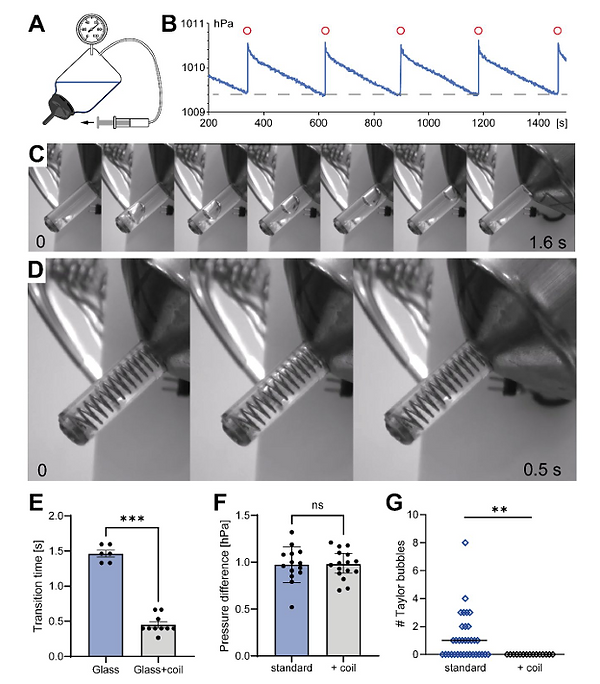
Fig. 3: Wire coil insert prevents air locks. A) Experimental apparatus to monitor bottle pressure during
continuous suction via syringe pump. B) Whenever the bottle pressure drops below threshold (dashed line), an air bubble is generated and rises in the bottle (red circles). Each bubble reduces the pressure differential by ~1 hPa, generating a sawtooth pattern. Atmospheric pressure was 1012 hPa. C) Movie frames of a spontaneous pressure equalization event. A Taylor bubble forms rapidly and moves slowly through the sipper tube. D) The same glass tube with wire coil insert. The bubble rapidly passes through the coil in a single movie frame (7.5 fps). E) Coil insert significantly speeds up bubble transition. Bars show mean ± SEM. n = 6, 10 events. Welch’s t test, ***p < 0.0001. F) Bottle pressure drop (before/after bubble event) is not affected by coil insert. Bars show mean ± SEM. n = 14, 16 events. Welch’s t test, p = 0.99. G) Coil insert reduces the probability of trapped bubbles in metal sipper tubes to zero. Each open diamond corresponds to a bottle (n = 34, 15 b